Types of Artificial Intelligence for Beginners, Students, and Professionals
Published: 12 Jan 2026
Have you ever used your phone’s voice assistant to set an alarm or ask for the weather and wondered how it seems to understand exactly what you need?That’s an example of one type of artificial intelligence at work. As AI becomes a bigger part of our lives, it’s helpful to know what different types exist and how they work.Understanding the types of artificial intelligence can make it easier to see how AI impacts everything from self-driving cars to the apps we use daily. In this guide, we’ll explore the different types of AI in simple language, so you can get a clearer picture of how they work and how they’re shaping our world.
What Are the Types of Artificial Intelligence?
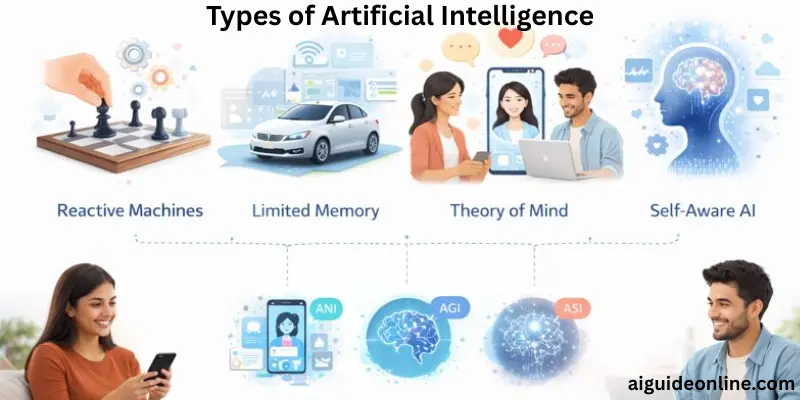
The types of artificial intelligence refer to the different ways machines can be designed to think and learn. Some machines are built to handle only one task, while others can learn from experience and improve over time.These types are classified based on how much they can understand, learn, and adapt to new situations.Some AI systems can make decisions based on data, while others are more advanced and can interact with humans on a deeper level.Knowing the types helps us understand how AI is used in various technologies we interact with every day.
Types of Artificial Intelligence
Artificial Intelligence comes in many forms, each with its own purpose and level of ability. Knowing the different types of Artificial Intelligence helps us understand how machines evolve from basic automation to advanced thinking systems.Here’s a simple list of all the main types of AI:
- Reactive Machines
- Limited Memory
- Theory of Mind
- Self-Aware AI
- Artificial Narrow Intelligence (ANI)
- Artificial General Intelligence (AGI)
- Artificial Superintelligence (ASI)
- Cognitive AI
- Emotional AI (Affective Computing)
- Hybrid AI
- Generative AI
Reactive Machines
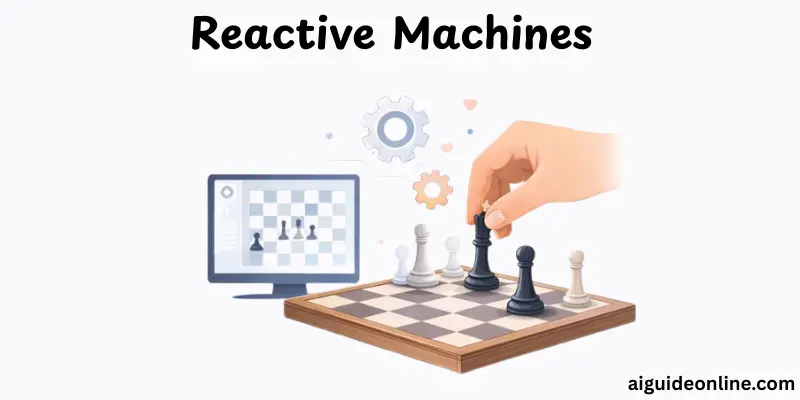
Reactive Machines are the oldest and simplest form of Artificial Intelligence.They don’t have memory or the ability to learn from past actions.They react to situations based only on what’s happening right now, following set rules to make quick decisions.
Key Features:
- Works only with present data
- No memory or learning ability
- Performs specific, pre-defined tasks
- Delivers fast and accurate responses
- Cannot adapt to new situations
Real-World Examples:
- IBM’s Deep Blue chess computer that defeated Garry Kasparov
- Basic spam filters that block unwanted emails
- Simple robot vacuum cleaners that change direction when they hit an obstacle
Limited Memory
Limited Memory is a type of Artificial Intelligence that can use past data to make better decisions.It stores small amounts of information for a short time and uses it to improve future actions.This makes it smarter than reactive machines, as it can learn from experience to some extent.
Key Features:
- Learns from past data or events
- Makes better predictions and decisions over time
- Has short-term memory for limited information
- Commonly used in self-learning systems
- Improves accuracy with repeated experiences
Real-World Examples:
- Self-driving cars that learn from past driving data
- Virtual assistants like Siri or Alexa adapting to user habits
- Chatbots that remember previous conversations for better responses
Theory of Mind
Theory of Mind is a type of Artificial Intelligence designed to understand human emotions, thoughts and intentions. It aims to make machines capable of interacting socially and recognizing how people feel or think.This type of AI focuses on building trust and empathy between humans and machines.
Key Features:
- Understands emotions, beliefs and social cues
- Predicts human reactions based on behavior
- Communicates naturally and builds emotional connections
- Adapts its responses according to the user’s mood
- Bridges the gap between human thinking and machine intelligence
Real-World Examples:
- Emotion-recognition robots used in therapy or elderly care
- AI-driven customer support that senses frustration and adjusts tone
- Virtual characters in games that react to players’ feelings
Self-Aware AI
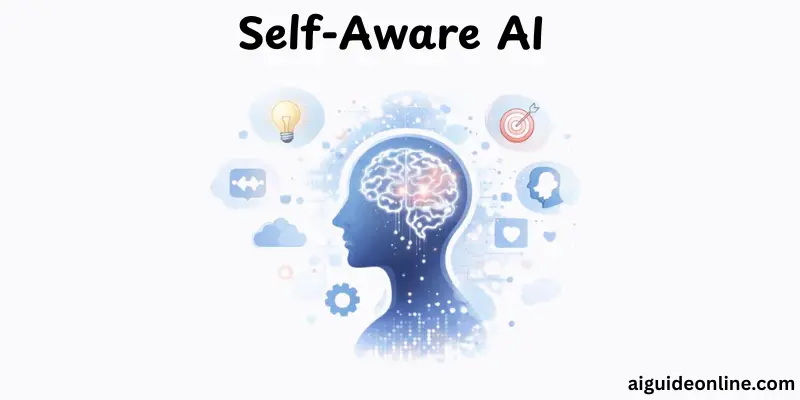
Self-Aware AI represents the most advanced and hypothetical stage of Artificial Intelligence, where machines possess their own consciousness and self-understanding. These systems would not only think and learn but also recognize their emotions, goals, and existence, similar to human awareness.
Key Features:
- Understands its own state, emotions and motives
- Makes independent decisions without human input
- Learns from past experiences to shape future behavior
- Shows awareness of human emotions and reactions
- Possesses deep reasoning and adaptive intelligence
Real-World Examples:
- Currently, Self-Aware AI doesn’t exist, but research is ongoing in advanced robotics and neuroscience.
- Fictional examples include characters like “Jarvis” from Iron Man or “Samantha” from the movie Her.
- Early experiments in cognitive modeling aim to mimic self-awareness in limited forms.
Artificial Narrow Intelligence (ANI)
Artificial Narrow Intelligence (ANI) is the most common types of Artificial Intelligence used today.It focuses on performing one specific task with great accuracy and speed but cannot think or act beyond that task.ANI systems follow programmed rules and data patterns to complete goals efficiently.
Key Features:
- Designed for a single, specific purpose
- Learns from large amounts of data
- Performs specific tasks more quickly and properly than humans
- Cannot think or make decisions outside its training
- Commonly used in everyday technology and business tools
Real-World Examples:
- Voice programs including Siri, Alexa and Google Assistant
- Recommendation systems used by Netflix, YouTube and Amazon
- Facial recognition software in smartphones and security systems
Artificial General Intelligence (AGI)
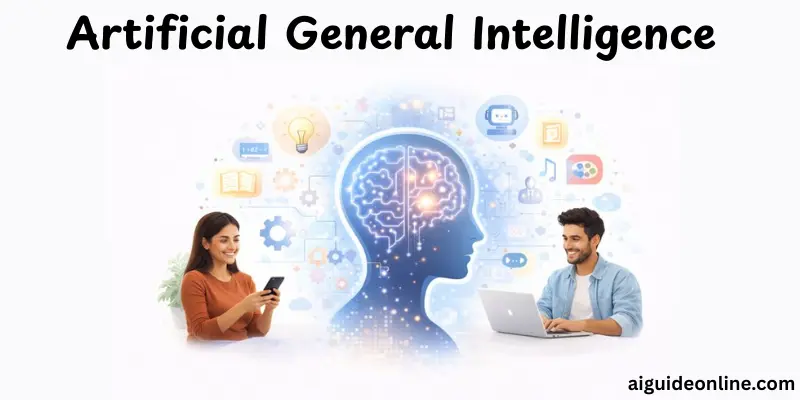
Artificial General Intelligence (AGI) refers to a form of Artificial Intelligence that can understand, learn and apply knowledge across many different tasks—just like a human being.It aims to match human intelligence in reasoning, creativity and emotional understanding.AGI can solve new problems without needing special programming or training for each task.
Key Features:
- Can think, learn, and reason across various subjects
- Understands emotions, context and human behavior
- Adapts to new challenges without specific instructions
- Shows creativity and problem-solving abilities similar to humans
- Capable of transferring knowledge from one area to another
Real-World Examples:
- Advanced humanoid robots under development, like Hanson Robotics’ Sophia
- Research projects at OpenAI and DeepMind working toward human-like intelligence
- Experimental AI models that simulate reasoning and decision-making beyond specific tasks
Artificial Superintelligence (ASI)
Artificial Superintelligence (ASI) is the most advanced level of AI, where machines surpass human intelligence in every way. It can think, reason, and create ideas far beyond human understanding.ASI would not only perform tasks faster but also make better judgments, invent new technologies and even improve itself without help.
Key Features:
- Exceeds human intelligence in every field, from science to art
- Learns and evolves on its own without human guidance
- Solves complex global problems with advanced reasoning
- Processes information and makes decisions much faster than humans
- Has potential for creativity, innovation and independent thinking
Real-World Examples:
- No real ASI exists yet, but it’s a major goal for future AI research
- Futuristic concepts in movies like Her and Ex Machina show what ASI might look like
- Theoretical models developed by researchers exploring how machines could achieve self-improving intelligence
Cognitive AI
Cognitive AI is types of Artificial Intelligence designed to mimic the way humans think, reason, and learn from experience. It combines elements of psychology, neuroscience and computer science to help machines understand information, make sense of it, and respond intelligently.The goal of Cognitive AI is to create systems that can think and adapt just like the human brain.
Key Features:
- Understands and interprets language, tone and context like humans
- Learns from past experiences to make smarter decisions
- Uses reasoning and logic to solve complex problems
- Adapts its responses based on emotions, situations, or new data
- Enhances collaboration between humans and machines through natural communication
Real-World Examples:
- IBM Watson, which helps doctors analyze medical records and suggest treatments
- Microsoft Cortana, which understands voice commands and assists users smartly
- Google DeepMind, which uses reasoning and learning to master complex challenges like Go and protein folding
Emotional AI (Affective Computing)
Emotional AI, also known as Affective Computing,focuses on identifying, comprehending, and responding to human emotions. It studies facial expressions, voice tones and body language to sense how a person feels. The goal is to make machines more empathetic and capable of natural interaction with people.
Key Features:
- Detects human emotions through voice, text and facial cues
- Adapts responses based on emotional states for better communication
- Uses sensors and cameras to analyze mood changes in real time
- Improves customer service, healthcare and learning through empathy
- Builds stronger human–machine relationships by understanding feelings
Real-World Examples:
- Affectiva, a company that develops emotion-recognition software for cars and marketing
- Replika, a chatbot app that responds with empathy to user emotions
- Apple’s Face ID system, which reads facial expressions to unlock devices and personalize user experiences
Hybrid AI
Hybrid AI is a powerful approach that combines different types of Artificial Intelligence, like Machine Learning, Deep Learning and Symbolic AI, to create smarter and more flexible systems. It uses both data-driven learning and rule-based reasoning to make balanced and accurate decisions.This mix helps machines handle real-world tasks with greater understanding and reliability.
Key Features:
- Merges logic-based reasoning with learning from data
- Offers higher accuracy and adaptability in decision-making
- Works well with both structured and unstructured information
- Reduces errors by using multiple AI methods together
- Enables complex problem-solving across various industries
Real-World Examples:
- IBM Watson, which blends symbolic reasoning with machine learning to analyze data
- Tesla’s Autopilot, using hybrid models for visual recognition and decision control
- Healthcare diagnostic systems, combining expert rules and learning algorithms for accurate medical predictions
Generative AI
Generative AI is a type of AI that creates new content such as text, images, music, and videos by learning from existing data. It doesn’t just analyze information—it generates original and creative outputs that resemble human work. This technology is transforming industries by automating creativity and innovation.
Key Features:
- Learns patterns from large datasets to produce realistic content
- Generates text, visuals, and sounds similar to human creations
- Supports creativity in design, art, writing, and media
- Continuously improves through feedback and training
- Helps automate content production, saving time and resources
Real-World Examples:
- ChatGPT, which creates human-like text responses and content
- DALL·E, an AI model that generates detailed images from text prompts
- Runway ML, used by designers and filmmakers to produce creative visuals and videos
Best types of Artificial Intelligence
This is truly one of the best types of Artificial Intelligence because it brings smart learning, problem-solving, and creativity together. It’s the kind of technology that makes our lives easier and more exciting every single day.
- Learns quickly and improves with experience
- Helps people make better, faster decisions
- Works smartly in real-life situations
- Brings innovation to everyday tools and devices
- Makes technology feel more human and helpful
Conclusion
So, folks, we’ve covered everything about the types of Artificial Intelligence—from how each one works to where you can find them in real life. We’ve seen how they’re changing the way we live, work, and think every day. Understanding these types helps you see how technology is shaping the world around us.
My advice? Keep learning about Artificial Intelligence because it’s not just the future—it’s already part of our lives. The more you know, the better you can use it to grow and stay ahead. Stay curious, buddies, and keep exploring the world of smart technology!
FAQs
Here are some most common asked questions about types of Artificial Intelligence:
The four types of Artificial Intelligence are Reactive Machines, Limited Memory, Theory of Mind and Self-Aware AI. Each one shows a different level of learning and understanding. They range from simple decision-making to human-like thinking.
ChatGPT is a form of Artificial Narrow Intelligence (ANI). It can understand language, answer questions, and create text, but it focuses only on specific tasks—it doesn’t think or feel like humans.
The three types are Artificial Narrow Intelligence (ANI), Artificial General Intelligence (AGI) and Artificial Superintelligence (ASI). They represent how machines grow in intelligence and ability.
The main seven areas include Machine learning, deep learning, natural language processing, computer vision, robotics, expert systems and speech recognition. These areas help machines learn, see, talk, and make smart decisions in real-world tasks.
The most common type today is Artificial Narrow Intelligence (ANI). These systems focus on a single task, like voice assistants, recommendation engines, or chatbots. They are fast, accurate, and widely used in daily life, even though they cannot think beyond their specific purpose.
Limited Memory AI may learn from previous data to improve decisions. For example, self-driving cars remember past routes and obstacles to drive safer. It doesn’t store everything forever, but it uses recent experiences to get better at its task.
Currently, Self-Aware AI doesn’t exist. Scientists are still researching it, and it would need the ability to understand emotions, thoughts, and its own existence. For now, AI can mimic thinking but cannot truly feel or be conscious like humans.



- Be Respectful
- Stay Relevant
- Stay Positive
- True Feedback
- Encourage Discussion
- Avoid Spamming
- No Fake News
- Don't Copy-Paste
- No Personal Attacks
- Be Respectful
- Stay Relevant
- Stay Positive
- True Feedback
- Encourage Discussion
- Avoid Spamming
- No Fake News
- Don't Copy-Paste
- No Personal Attacks
