The Role of AI in Education: Benefits, Use Cases, and Future Impact
Published: 16 Jan 2026
Artificial intelligence (AI) is increasingly shaping how education systems operate, how teachers teach, and how students learn. Governments, universities, and schools worldwide are exploring AI not as a replacement for educators, but as a tool to improve efficiency, accessibility, and learning outcomes.
Research from the UK Department for Education (DfE) shows that by late 2023, 42% of primary and secondary teachers and 74% of online 16–24-year-olds in the UK had already used generative AI tools, highlighting how rapidly the technology has entered education spaces.This guide explores what ai in education means, how it is used in practice, its advantages and disadvantages, real-world examples, and what the future may hold.
What is Artificial Intelligence in Education?
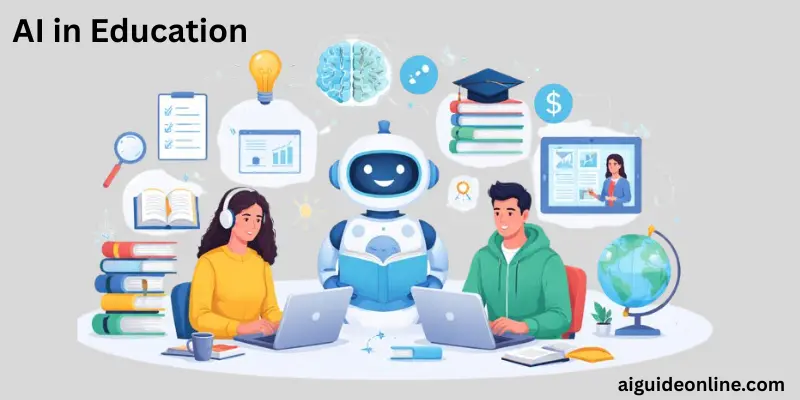
Artificial intelligence(AI) in education refers to the use of computer systems capable of performing tasks that normally require human intelligence, such as understanding language, recognizing patterns, learning from data, and generating content, to support teaching and learning.
The Alan Turing Institute defines generative AI as systems that can produce text, images, audio, video, or other media in response to user prompts. In education, this includes tools that generate lesson plans, provide explanations, summarize materials, or assist with assessment preparation.
From a policy perspective, governments emphasize that AI should support, not replace, teachers. UNESCO’s global guidance on generative AI in education stresses a human-centred approach, where AI enhances educational delivery while preserving human agency, ethical safeguards, and pedagogical oversight.
Artificial Intelligence in Education Examples
Artificial intelligence is already embedded in many educational settings, often in ways that are not immediately visible. According to the UK DfE’s call for evidence on generative AI, educators are using AI tools to assist with lesson preparation, summarizing content, and reducing administrative workload, while students commonly use AI for explanations, revision, and idea generation.Globally, UNESCO identifies common AI-enabled educational applications such as:
- Automated feedback and assessment support
- AI-assisted content creation
- Student support chatbots
- Accessibility tools such as speech-to-text and translation
These examples show that AI is not a single tool, but a broad ecosystem of technologies supporting multiple aspects of education.
Use of AI in Education
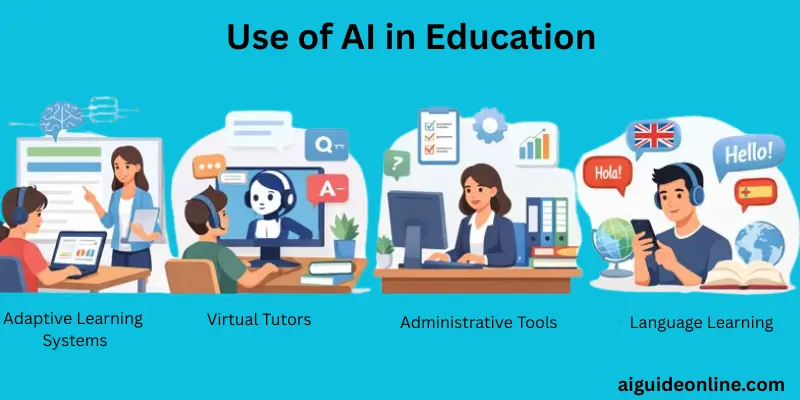
AI is widely used in education to support teaching, improve learning experiences, and reduce the workload of educators. From personalized learning systems to administrative support and assessments, AI is applied in practical ways that enhance both classroom and online education.Here are some uses of ai in education:
Adaptive Learning Systems
Adaptive learning systems use AI algorithms to analyze student performance and adjust learning materials in real time. Research on intelligent tutoring and adaptive systems indicates that such approaches can improve learning outcomes when compared with non-adaptive instruction, particularly when systems are well designed and integrated into teaching.
Virtual Tutors
Virtual tutors and AI teaching assistants provide students with on-demand support outside classroom hours. One well-documented example is Georgia Tech’s “Jill Watson”, an AI-powered teaching assistant used in an online computer science program to answer student questions. Studies from Georgia Tech show that students often did not realize they were interacting with an AI, demonstrating the potential of virtual tutors to scale support in large courses.
Administrative Tools
AI is increasingly used to reduce administrative burden on educators. DfE research highlights interest in using generative AI to assist with drafting communications, organizing resources, and managing routine documentation, allowing teachers to focus more time on instruction and student support.
Language Learning
AI supports language learning through tools such as real-time translation, conversational practice, and automated feedback. UNESCO notes that these tools can support multilingual education and learners for whom the language of instruction is not their first language, while also warning of the need to monitor accuracy and cultural bias.
Predictive Analytics
Predictive analytics systems analyze attendance, engagement, and assessment data to identify students who may be at risk of falling behind. A 2025 rapid evidence assessment found that predictive analytics can support early intervention strategies, although outcomes depend heavily on data quality, transparency, and ethical use.
Exam Proctoring
AI-based exam proctoring tools monitor test environments using webcams, screen tracking, and behavior analysis. While these systems can help maintain assessment integrity, multiple studies highlight concerns related to privacy, transparency, stress, and algorithmic fairness, especially in remote testing contexts.
The Advantages of AI in Education
AI brings meaningful improvements to education by making learning more personalized and teaching more efficient. It helps students learn better while supporting educators in managing time and resources effectively.Here are few benefits of ai in eduction:

Personalized Learning
AI enables more personalized learning experiences by adapting content to individual learner needs. Meta-analyses of intelligent tutoring systems show that personalized, adaptive instruction can lead to improved academic performance compared to traditional one-size-fits-all approaches.
Immersive Learning Experiences
AI supports immersive learning through interactive simulations, virtual environments, and adaptive digital content. UNESCO highlights that such experiences can enhance engagement when used thoughtfully, particularly in subjects that benefit from visualization and experimentation.
Improved Student Engagement and Motivation
By delivering content at an appropriate level of challenge and providing immediate feedback, AI-driven systems can help sustain student engagement. Research on adaptive and tutoring systems suggests that timely feedback is a key factor in learner motivation.
Cost-Effective Learning
AI can make education more cost-effective by automating repetitive tasks such as grading or content organization. While AI implementation itself requires investment, policy bodies note its potential to improve efficiency at scale, particularly in large or online learning environments.
Integrated Learning and Intelligent Tutoring System
Integrated intelligent tutoring systems combine instruction, practice, and feedback within a single platform. Evidence from multiple controlled studies indicates that such systems can approximate some benefits of one-to-one tutoring when carefully designed.
Continuous Evaluation and Improvement in the Long Run
AI systems enable continuous monitoring of learning outcomes, allowing educators to refine teaching strategies over time. The OECD emphasizes that data-driven improvement must be paired with transparency, accountability, and human oversight.
Raising Academic Standards and Educational Quality
When aligned with curriculum goals and ethical standards, AI has the potential to improve consistency in assessment, expand access to quality resources, and support evidence-based teaching practices. UNESCO cautions that these benefits depend on equitable access and responsible implementation.
The Disadvantages of AI in Education
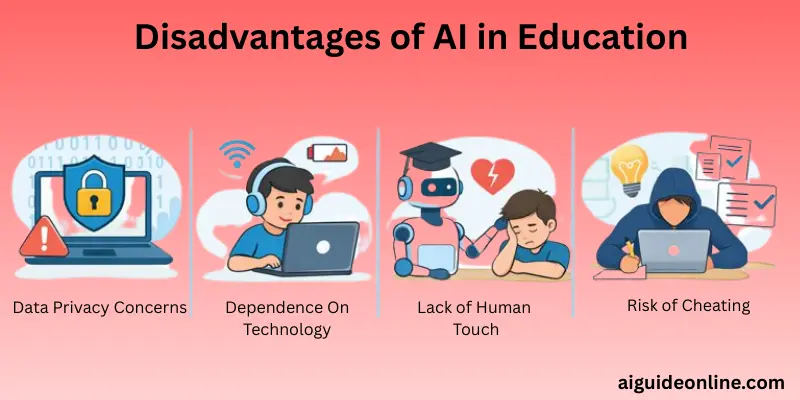
While artificial intelligence offers many benefits, it also brings challenges that need careful consideration. Issues such as privacy, over-reliance on technology, and reduced human interaction highlight the need for responsible and balanced use of AI in education.Here are some drawbacks of ai in eduction:
Data Privacy Concerns
AI systems rely on large volumes of student data, raising significant privacy concerns. Regulations such as FERPA in the United States and GDPR in the European Union establish strict rules for handling educational data, yet UNESCO notes that many institutions lack the technical and legal readiness to fully comply when adopting AI tools.
Dependence On Technology
Overreliance on AI tools can create vulnerabilities, including disruption during technical failures and reduced development of independent problem-solving skills. The OECD stresses that AI should augment—not replace—human decision-making.
Lack of Human Touch/Dehumanized Learning Experience
Education relies heavily on human interaction, mentorship, and emotional support. UNESCO warns that excessive automation risks weakening the social and relational aspects of learning if not balanced with human-led teaching.
Risk Of Cheating
Generative AI can be misused by students to complete assignments or generate exam answers. UNESCO highlights the need to redesign assessment methods and strengthen academic integrity policies rather than relying solely on detection tools.
Teacher Job Displacement
While fears of teacher replacement persist, international policy guidance consistently emphasizes that AI should support educators. The main risk lies not in job loss, but in inadequate training and unclear role definitions during AI adoption.
Future of AI in Education
The future of AI in education will be shaped by policy, ethics, and capacity building. UNESCO calls for global cooperation to ensure AI literacy, teacher training, and governance frameworks that protect learners’ rights. Similarly, the OECD emphasizes trustworthy AI grounded in fairness, transparency, and accountability.
Rather than banning AI, experts argue that education systems should prepare students to use AI critically and responsibly, as AI literacy is expected to be a core skill in the future workforce.
Incorporate AI in Education with Oyelabs
Organizations like Oyelabs position themselves as AI development partners for education, offering custom AI solutions for learning platforms, analytics, and automation. Any implementation should align vendor capabilities with institutional goals, regulatory requirements, and ethical standards, ensuring AI serves educators and learners effectively.
Conclusion
Artificial intelligence is already influencing education at every level, from classrooms to national policy. Evidence shows that AI can enhance personalization, efficiency, and accessibility when implemented responsibly. At the same time, risks related to privacy, equity, and human connection must be carefully managed. The future of AI in education depends not on the technology itself, but on how thoughtfully it is governed, taught, and integrated into human-centred learning environments.
FAQs
Here are some common asked questions about AI in education:
AI is used for personalized learning, tutoring, assessment support, administrative efficiency, accessibility tools, and data-driven insights.
No. International guidance consistently emphasizes that AI should support, not replace, educators.
It can be, but only if institutions comply with data protection laws such as GDPR and FERPA and implement strong governance measures.
By setting clear goals, training educators, ensuring legal compliance, and adopting AI gradually with continuous evaluation.
AI helps people learn faster by personalizing content to their needs. It saves time by automating repetitive tasks like grading and scheduling. AI improves access to education through tools like speech-to-text and translation. It supports better decision-making using data and insights. AI also makes learning more engaging with interactive and adaptive tools.
In 2026, AI plays a supporting role by personalizing learning and assisting teachers rather than replacing them. Schools and universities use AI to track progress, offer timely support, and reduce administrative workload. AI also helps improve accessibility and inclusion for diverse learners. The focus is on responsible use with clear rules and human oversight.





- Be Respectful
- Stay Relevant
- Stay Positive
- True Feedback
- Encourage Discussion
- Avoid Spamming
- No Fake News
- Don't Copy-Paste
- No Personal Attacks
- Be Respectful
- Stay Relevant
- Stay Positive
- True Feedback
- Encourage Discussion
- Avoid Spamming
- No Fake News
- Don't Copy-Paste
- No Personal Attacks
