Advantages and Disadvantages of AI: A Complete Guide
Published: 13 Jan 2026
Artificial Intelligence means machines or software that can perform tasks that usually need human thinking. Some tasks are done faster and more accurately with this technology. Knowing the advantages and disadvantages of AI is important because it helps us use it wisely and avoid problems. In this article, you will learn the main benefits it brings, the challenges it can create, and how it affects our daily life and work.
Advantages of AI
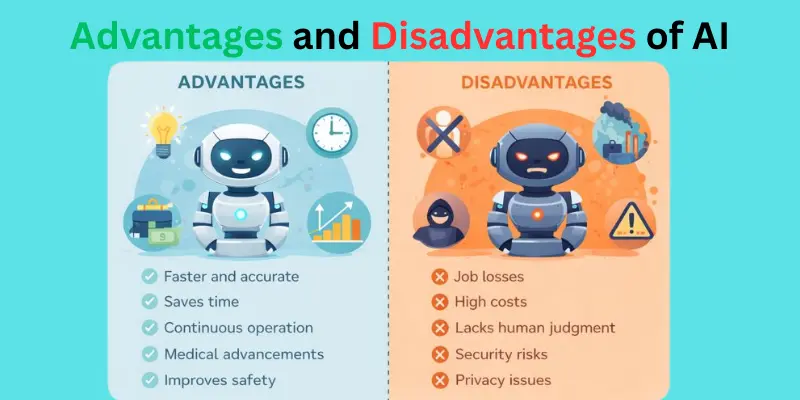
Artificial Intelligence brings many benefits that make tasks faster, easier, and more efficient. It helps people and businesses save time, reduce errors, and make better decisions. From daily life to industry, its applications improve productivity and convenience. Here are the key advantages:
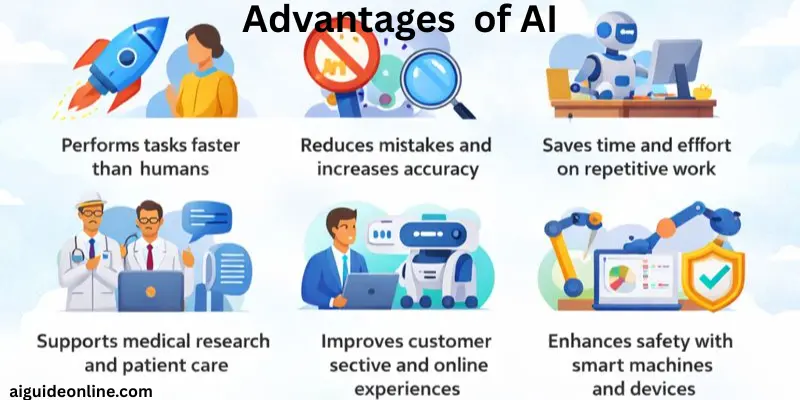
- Performs tasks faster than humans
- Reduces mistakes and increases accuracy
- Saves time and effort on repetitive work
- Supports medical research and patient care
- Improves customer service and online experiences
- Enhances safety with smart machines and devices
- Helps businesses make informed decisions with data insights
- Works continuously without breaks
- Provides personalized learning and entertainment
- Encourages innovation and creative solutions
1. Performs tasks faster than humans
Artificial Intelligence can handle tasks much quicker than people. It processes information and completes jobs in a fraction of the time. This speed helps businesses, schools, and everyday life run more smoothly. Quick results also reduce waiting time for important decisions.
- Saves valuable time in work and daily tasks
- Handles large amounts of data efficiently
- Speeds up processes in industries and services
2. Reduces mistakes and increases accuracy
Machines following rules and patterns make fewer errors. This means results are more reliable than human work in many cases. Accuracy is important in areas like finance, healthcare, and data analysis. It helps prevent costly mistakes and improves quality.
- Minimizes human errors in work
- Ensures consistent results every time
- Improves trust in decisions and outcomes
3. Saves time and effort on repetitive work
AI can take over routine and boring tasks. People can focus on more important and creative work. It reduces fatigue and makes workplaces more efficient. Everyday chores can also be handled faster.
- Frees humans from repetitive jobs
- Increases overall productivity
- Reduces stress and workload
4. Supports medical research and patient care
AI helps doctors analyze large amounts of medical data quickly. It can detect patterns in tests or scans that humans may miss. This improves early diagnosis and treatment planning. Patients get better and faster care.
- Assists in accurate disease detection
- Speeds up medical research and analysis
- Improves patient care and treatment outcomes
5. Improves customer service and online experiences
AI can answer questions and solve problems anytime. It helps companies respond quickly to customers. Personalized suggestions and services make users happier. Businesses can provide better support around the clock.
- Provides instant support to users
- Offers personalized experiences and recommendations
- Operates 24/7 without delays
6. Enhances safety with smart machines and devices
Machines can monitor and respond to dangerous situations quickly. This helps in workplaces, transport, and home safety. AI systems can prevent accidents and reduce risks for people. Safety standards improve overall.
- Detects risks faster than humans
- Reduces workplace and transport accidents
- Protects people and property efficiently
7. Helps businesses make informed decisions with data insights
AI can analyze data to find useful trends and patterns. Companies can make better decisions based on this information. It reduces guesswork and increases profits. Decision-making becomes faster and smarter.
- Provides clear insights from complex data
- Reduces errors in business planning
- Supports strategic growth and efficiency
8. Works continuously without breaks
Machines don’t get tired or need rest. They can work 24 hours a day without losing performance. This is very useful in factories, online services, and critical tasks. Continuous work improves overall output.
- Maintains consistent productivity
- Handles tasks during night or holidays
- Supports operations without human fatigue
9. Provides personalized learning and entertainment
AI adapts to individual preferences and needs. Students can get lessons suited to their learning pace. Streaming apps suggest movies and music based on what users like. Personalization makes experiences more enjoyable and effective.
- Adapts to individual needs and preferences
- Improves learning outcomes and engagement
- Enhances entertainment experiences
10. Encourages innovation and creative solutions
AI helps generate ideas and solutions quickly. People can experiment and improve products using AI suggestions. It pushes boundaries in art, design, science, and technology. Innovation becomes easier and faster.
- Supports creative problem-solving
- Speeds up development and innovation
- Helps explore new ideas efficiently
Disadvantages of AI
While Artificial Intelligence brings many benefits, it also has some drawbacks that are important to know. AI can sometimes reduce human jobs, cost a lot to set up, and may make mistakes if it’s not properly managed. Understanding these disadvantages helps people and businesses use AI safely and wisely. Here’s a simple list of the main drawbacks:
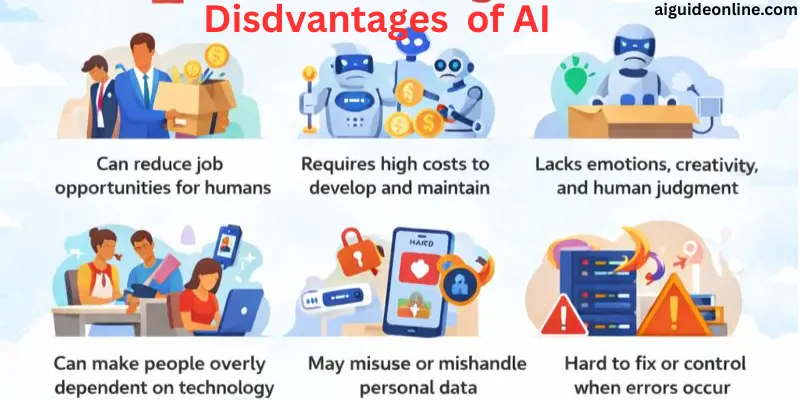
- Can reduce job opportunities for humans
- Requires high costs to develop and maintain
- Lacks emotions, creativity, and human judgment
- Can make people overly dependent on technology
- May misuse or mishandle personal data
- Hard to fix or control when errors occur
- Increases security risks if mismanaged
- Reduces face-to-face interaction and social skills
- May give wrong results if trained with poor data
- Can increase the gap between developed and underdeveloped countries.
1. Can reduce job opportunities for humans
AI can perform tasks that people used to do. This may lead to fewer jobs in some industries. Workers may need to learn new skills to stay relevant. While AI creates new jobs, some traditional roles might disappear. It can affect factory, office, and service work.
- Replaces repetitive or manual tasks
- Requires workforce to adapt to new roles
- May increase unemployment in some sectors
2. Requires high costs to develop and maintain
Setting up AI systems can be very expensive. Companies need special software, hardware, and skilled staff. Regular maintenance and updates also add to costs. Small businesses may find it hard to afford. High expenses can limit who benefits from AI.
- Needs significant investment for setup
- Ongoing maintenance adds to costs
- Limits accessibility for smaller organizations
3. Lacks emotions, creativity, and human judgment
AI cannot truly feel emotions or make moral decisions. It cannot replace human creativity or intuition. Some tasks need empathy, ethics, or judgment that machines cannot provide. This limits its use in areas like counseling, teaching, or leadership. AI follows rules and patterns, not human thought.
- Cannot empathize or understand feelings
- Lacks human intuition and moral reasoning
- Not suitable for emotional decision-making
4. Can make people overly dependent on technology
Relying too much on AI may weaken human skills. People might stop learning how to solve problems themselves. Over-dependence can lead to mistakes if the system fails. It’s important to balance AI use with personal judgment. Skills like critical thinking may decline over time.
- Reduces independent problem-solving
- Creates reliance on machines for tasks
- Skills may weaken without practice
5. May misuse or mishandle personal data
AI systems often process large amounts of personal information. If mismanaged, this data can be exposed or misused. Privacy concerns are a serious issue for individuals and businesses. Proper rules and security are needed to protect sensitive information. Data breaches can cause financial and personal harm.
- Risk of personal information being leaked
- Can be used for unfair profiling or marketing
- Needs strong security measures
6. Hard to fix or control when errors occur
AI can sometimes make mistakes or behave unexpectedly. Fixing these issues may require experts and a lot of time. Complex systems are harder to manage and control. Errors in important sectors like healthcare and banking can be costly. Humans need to monitor AI constantly.
- Errors can cause significant problems
- Requires skilled staff to troubleshoot
- Complex systems are difficult to control
7. Increases security risks if mismanaged
AI can be targeted by hackers or used for cyber attacks. Poorly protected systems may allow unauthorized access. This can harm businesses, governments, and individuals. Security protocols must be strong and constantly updated.Misuse of AI can have major effects.
- Vulnerable to hacking and cyber attacks
- Can be used to create security threats
- Needs constant monitoring and protection
8. Reduces face-to-face interaction and social skills
Relying on AI for communication can limit personal interaction. People may prefer machines to humans for tasks like customer support. Social skills can decline when human contact is reduced. This can affect teamwork, empathy, and relationships. Balance is important between AI and real-life interactions.
- Less human-to-human communication
- Social skills may weaken
- Can affect teamwork and collaboration
9. May give wrong results if trained with poor data
AI systems develop based on the information they receive. If the data is incomplete, biased, or incorrect, AI may make mistakes. Poor results can lead to wrong decisions in business, healthcare, or education. It’s important to use accurate and high-quality data. Humans must check AI outputs carefully.
- Errors come from bad or biased data
- Can lead to wrong decisions
- Needs regular verification and updates
10. Can widen the gap between developed and developing countries
AI technology is expensive and advanced. Wealthy countries can adopt it faster, gaining more benefits. Poorer regions may fall behind due to lack of access. This creates inequality in education, healthcare, and industry. Bridging the gap requires affordable AI solutions worldwide.
- Access to AI is limited in poorer regions
- Can increase global inequality
- Needs strategies for fair adoption
Helpful Tips for Understanding Advantages and Disadvantages of AI
Learning about the benifits and drawbacks of AI can be difficult to understand, but a few easy ideas can help. These tips help you see both sides clearly and use technology wisely.
- Start with the basics – Learn what AI does and where it’s used before diving into pros and cons.
- Observe real-life examples – Watch how AI is applied in apps, devices, or services you use daily.
- Think about both sides – For every benefit, consider possible risks or drawbacks.
- Stay updated – Technology changes fast, so read articles or news to keep your knowledge fresh.
- Ask questions – Discuss AI with friends or online communities to get different perspectives.
- Try simple tools – Experiment with beginner-friendly AI apps to understand how it works firsthand.
Conclusion
In this article, we explored the advantages and disadvantages of AI. We saw how it can make work easier, faster, and more accurate, but also how it can bring challenges like job changes or privacy concerns. Understanding both sides helps us use technology wisely and safely. The benefits and drawbacks go hand in hand, showing that AI is powerful but needs careful use. Now it’s your turn to think smart and decide how to make the most of it.
FAQs about Advantages and Disadvantages of AI
These are some most common askes questions about advantages and disadvantages of AI:
AI can make tasks faster and more efficient, helping us save time. It reduces human errors in many areas like data analysis and healthcare. AI can work 24/7 without needing rest. It helps in making better decisions by analyzing large amounts of information. AI also brings convenience to daily life through smart devices and apps.
AI can reduce some job opportunities because machines can do tasks humans used to do. It may be costly to create and maintain AI systems. AI lacks creativity and emotions, so it cannot fully understand human needs. There is a risk of privacy issues if personal data is misused. Sometimes AI can make mistakes if it is trained with poor or biased data.
Yes, AI is very useful because it makes life and work easier. It helps in areas like healthcare, transportation, and communication. However, we must use it carefully to avoid overdependence and privacy issues. AI is a tool, and how we use it decides whether it helps or causes problems. It’s not about replacing humans but supporting them to work smarter.
Artificial Intelligence helps complete tasks faster and more accurately than humans. It can reduce mistakes and save time in work or daily activities. Many systems learn from past experiences to improve results. AI also makes life easier through smart devices and services.
AI can replace some jobs, which may affect employment.It may be costly to create and maintain complex systems.AI doesn’t have emotions or creativity, so it cannot fully understand humans. Privacy and data misuse are possible if not handled carefully.
Use AI tools thoughtfully and combine them with human judgment. Regularly check results to prevent errors. Learn about safe practices and privacy protection. Balancing AI with personal skills helps you benefit without risks.
Understanding both sides helps you make smart decisions and use AI effectively. It prevents overdependence and surprises from unexpected problems. You can take advantage of AI while staying aware of its limits. This knowledge makes technology safer and more helpful.




- Be Respectful
- Stay Relevant
- Stay Positive
- True Feedback
- Encourage Discussion
- Avoid Spamming
- No Fake News
- Don't Copy-Paste
- No Personal Attacks
- Be Respectful
- Stay Relevant
- Stay Positive
- True Feedback
- Encourage Discussion
- Avoid Spamming
- No Fake News
- Don't Copy-Paste
- No Personal Attacks
